martes, 30 de octubre de 2012

Pride and Prejudice


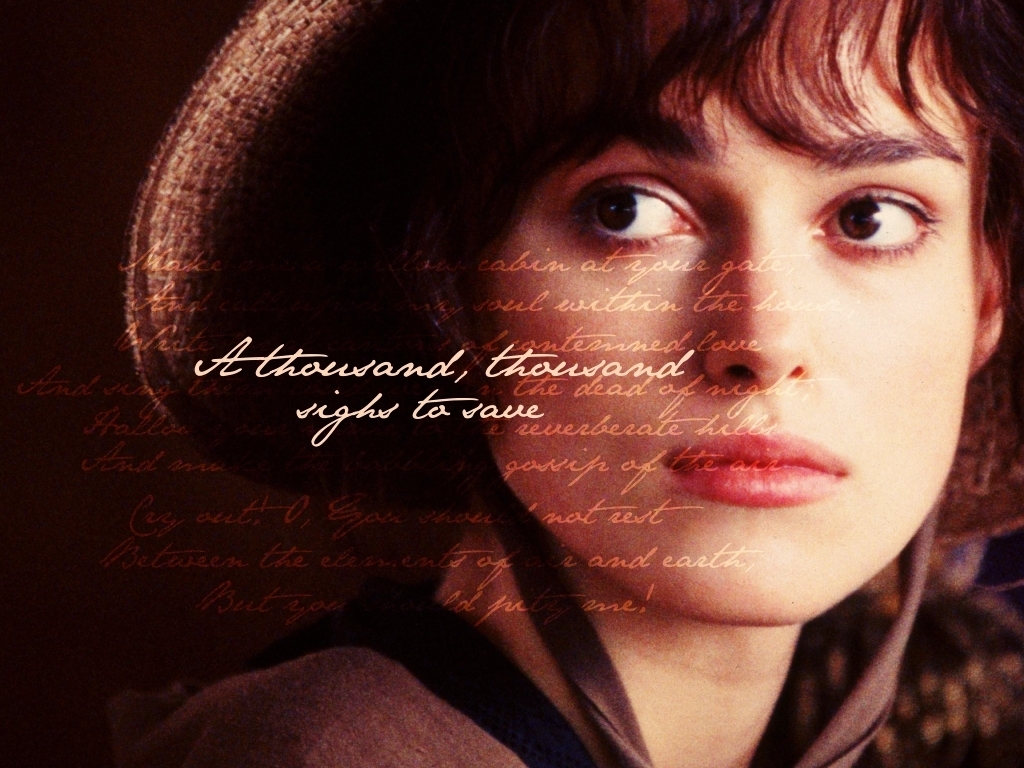
Pride and Prejudice is a novel written by Jane Austin that tell us the story of Elizabeth Bennett, a modern woman that fights versus the society of the early 19th-century England. She is the one that wants to choose who its going to be her husband, and not her parents. Eventhough the novel was written in 1813 it is very popular now a days. A recent film was made with Keria Knightley as the protagonist (2005).


1. Why do you think "Pride and Prejudice" continues to be a referent for modern tales?   

Because the conflict of the story can still be seen now a days, but in different ways and prespectives.

2. What do you think is the effect that these different authors (film directors, producers, modern writers) want to achieve in today's audiences?  

I think they want women to reflect about the relation between their life, and the protagonist life.

3. If you had to choose one of the previous versions to analyse, which would be the one and why?  

I would like to analyse the first version, because it is the more similar to the book, and I consider it is a very important fact, because it is the original novel the one that is rich in content and succes.


Page 287 Questions

1) What degrees of emancipation reinforcement of 18th-century family does Elizabeth Bennett's marriage to Mr. Darcy support?

Elizabeth Bennett's marriage has some emancipation values, for example, she is over-confident of her capacity to make independent decision. She chosed to marriage Mr. Darcy and not her mother. She rejected her future husband at first too.

2) What attitudes to marriage does Pride and Prejudice convey? What other options did Elizabeth Bennett have?

The attitude that "Pride and Prejudice" convey to marriage, is that women should be confident of their capacity to make decisions by their own, and they should judge by her selves if a man is the indicated or if he is not. Elizabeth could have rejected Mr. Darcy.


domingo, 28 de octubre de 2012

PEE Structure

This structure is very useful for essay or any case where you have to argument. The idea of PEE structure is to make your argument stronger by using evidence from a text. PEE stands for:


· Point: The point is the opinion or argument you stand for.

· Evidence: To give strenght to the argument, the next step is to put a quote from the original text to prove what you say is right.

· Explanation: The final step is to show the connection between the evidence and the point so its clear for everyone what is the background of your argument.

The PEE can only be used when there is the intention of introducing a quotation in the text. The importance of quoting is based in the strenght that the argument can get. And in an essay the arguments are the most important thing,

lunes, 22 de octubre de 2012

Jewish Traditions

File:ShemaMezuzah.jpg
Mezuzah


Mezuzah: A mezuzah is a piece of parchment (often contained in a decorative case) inscribed with specified Hebrew verses from the Torah (Deuteronomy 6:4-9 and 11:13-21). These verses comprise the Jewish prayer "Shema Yisrael", beginning with the phrase: "Hear, O Israel, the LORD our God, the LORD is One"
(http://en.wikipedia.org/wiki/Mezuzah  16/10/12  9:02am)


File:Tefillin.JPGTefillin: Tefillin, also called phylacteries, (from Ancient Greek phylacterion, meaning "to guard, protect") are a set of small black leather boxes containing scrolls of parchment inscribed with verses from the Torah, which are worn by observant Jews during weekday morning prayers. Although "tefillin" is technically the plural form (the singular being "tefillah"), it is loosely used as a singular as well. The hand-tefillin, or shel yad, is placed on the upper arm, and the strap wrapped around the arm, hand and fingers; while the head-tefillin, or shel rosh, is placed above the forehead. The Torah commands that they should be worn to serve as a "sign" and "remembrance" that God brought the children of Israel out of Egypt.
 (http://en.wikipedia.org/wiki/Tefillin 16/10/12  9:12am)

File:Shofar.JPG
Shofar:
A shofar, is a horn, traditionally that of a ram, used for Jewish religious purposes. Shofar-blowing is incorporated in synagogue services on Rosh Hashanah and Yom Kippur. Shofar come in a variety of sizes.

 (http://en.wikipedia.org/wiki/Shofar   16/10/12)


Hanukkah: (sometimes transliterated Chanukkah) is a Jewish holiday celebrated for eight days and nights. It starts on the 25th of the Jewish month of Kislev, which coincides with late November-late December on the secular calendar.  In Hebrew, the word "hanukkah" means "dedication." The name reminds us that this holiday commemorates the re-dedication of the holy Temple in Jerusalem following the Jewish victory over the Syrian-Greeks in 165 B.C.E.

(http://judaism.about.com/od/holidays/a/hanukkah.htm  22/10/12)


File:Tzedakah (charity) box, Charleston, 1820, silver, National Museum of American Jewish History.JPGTzedakah: is a Hebrew word literally meaning righteousness but commonly used to signify charity. It is based on the Hebrew word (צדק, Tzedek) meaning righteousness, fairness or justice, and it is related to the Hebrew word Tzadik meaning righteous as an adjective (or righteous individual as a noun in the form of a substantive). In Judaism, tzedakah refers to the religious obligation to do what is right and just, which Judaism emphasises are important parts of living a spiritual life. Maimonides says that, while the second highest form of tzedakah is to anonymously give donations to unknown recipients, the highest form is to give a gift, loan, or partnership that will result in the recipient supporting himself instead of living upon others. Unlike philanthropy or charity, which are completely voluntary, tzedakah is seen as a religious obligation, which must be performed regardless of financial standing, and must even be performed by poor people. Tzedakah is considered to be one of the three main acts that can annul a less than favorable heavenly decree.

(http://en.wikipedia.org/wiki/Tzedakah)


Sabbath: According to Exodus 20:8-11, the Sabbath is the seventh day of the week, on which we are to rest, in remembrance that God created the universe in six days and then “rested” on the seventh day. However, due to the misunderstanding and misinterpretation of some Christian groups, the meaning of the Sabbath day rest has been confused.   Some Christian groups, such as the Seventh Day Adventists, view the Sabbath as the day of worship, the day on which Christians should attend church / worship services. While these groups typically also teach that no work is to be done on the Sabbath, the concept of the “day of worship” is sometimes more emphasized than the “day of rest.”

(http://www.gotquestions.org/Sabbath-day-rest.html)

jueves, 30 de agosto de 2012

The Help


The Help is a novel written by Kathryn Stockett in 2009 that in the 2011 was release as a film. The story is about a group of maids in the 60s and a group of a high social women, the idea was to show how this two groups interactuate, and if they have a good treatment. But in the 60s the discrimination was heavy and the black maids receive awful treatment.


"The maids in The Help took a risk by telling their stories. Even though they knew they could be shot to death in their front yards, they went ahead with the project. If people are not willing to take risks..."

"They won't change a thing"


The maids of the movie were tired of the discrimination that they received because of been black. They were constantly under the pressure of the Ku Klux Klan, that could kill any of them, and tired the way their bosses treat them. So they received an oportunity to tell all her stories to a periodist that would publicate all the material the maids gave her. It was a very risky chance because the black women could easily get shooted in the yard in front of her houses. But they decided to take the risk, because other wise nothing would change until otherone take the risk that they didn't. So I say that if people are not willing to take risks, they won't change a thing of the life and circumstanses that surround them.

miércoles, 29 de agosto de 2012

Jim Craw Law

File:Jim Crow Jubilee (Boston Public Library).jpg

The Jim Crow laws were state and local laws in the United States enacted between 1876 and 1965. They mandated de jure racial segregation in all public facilities in Southern states of the former Confederacy, with, starting in 1890, a "separate but equal" status for African Americans. The separation in practice led to conditions that tended to be inferior to those provided for white Americans, systematizing a number of economic, educational and social disadvantages. De jure segregation mainly applied to the Southern United States. Northern segregation was generally de facto, with patterns of segregation in housing enforced by covenants, bank lending practices, and job discrimination, including discriminatory union practices for decades. Some examples of Jim Crow laws are the segregation of public schools, public places, and public transportation, and the segregation of restrooms, restaurants, and drinking fountains for whites and blacks. The U.S. military was also segregated. These Jim Crow Laws followed the 1800–1866 Black Codes, which had previously restricted the civil rights and civil liberties of African Americans with no pretense of equality. State-sponsored school segregation was declared unconstitutional by the Supreme Court of the United States in 1954 in Brown v. Board of Education. Generally, the remaining Jim Crow laws were overruled by the Civil Rights Act of 1964[1] and the Voting Rights Act of 1965.


Source: http://en.wikipedia.org/wiki/Jim_Crow_laws (11:06 pm; 29/8/2012)

martes, 28 de agosto de 2012

Chapters 12 - 13 -14 Analysis Question - To Kill a Mockingbird


Ch. 12
1. Comment on Jem's and Scout's visit to First Purchase Church. What does Scout learn about how black people live?

Scout didn't know that black were so much poor than whites, and lived in so worst conditions. When she went to the church with calpurnia, Scout could see them and how they were. She recieve nice treats, because Atticus is defending Tom Robinson

2. Explain why Calpurnia speaks differently in the Finch household, and among her neighbours at church.

She, as an employee, must speak formally, because its her work and she must be serious and follow the rules the boss (Atticus) gives. Otherwise they would just get another employee more eficent

Ch. 13

3. Aunt Alexandra thinks Scout is "dull" (not clever). Why does she think this, and is she right? 

Because Scout is not behaving like a proper lady. And Aunt Alexandra is very worried about her family name approval

4. How does Aunt Alexandra involve herself in Macomb's social life?

She stablish friendship quickly inviting people to the Finch's place

5. Comment on Aunt Alexandra's ideas about breeding and family, in contrast to Atticus' visions. Who's right, do you think? Why?

I think Atticus is right, Becayse what realy Aunt Alexandra thinks is that children should act "normal", according to the society, no matter if they are good or bad. But Atticus thinks that kids should reflectionate about what is good and bad, and act as they think it's correct

Ch. 14. 

6. Comment on Atticus' definition of rape. How suitable is this definition as an answer to Scout?

When Scout ask Atticus what is rape, because that is why Tom Robison is accused for doing, Atticus said to his daughter: "Carnal knowledge of a female by force and without her concer". Atticus knew Scout wasn't in an age for understanding all the reproductive process, but by giving the exact definition of rape, he doesn't have to lie for avoiding Scout next question.

Analysis Chapter 15 - 16 — To Kill a Mockingbird

Ch. 15

1. What is the Ku Klux Klan? What do you think of Atticus' comment about it?

The Ku Klux Klan was an organization that wanted to eliminate afroamericans and any kind of black people. They were responsable of the murder of Martin Luther King. Atticus talked about this organization as if it was not important nor dangerous at all, what was false. He said it so their family won't be scared.

2. How does Jem react when Atticus tells him to go home, and why?

He doesn't obbey his father, because he knows he is in danger.

3. What persuades the lynching-party to give up their attempt on Tom's life?

The innocence of Scout

Ch. 16

4. What sort of person is Dolphus Raymond and what is your opinion of him?

He was a white man that lived with black men, because he thinks whites are hypocrits.

5. How does Reverend Sykes help the children see and hear the trial? Is he correct in doing so?

He leads them to where black men are so they can see the trial. I think so because is their father who is working and all the twon is there.